2D AD Dispersion
The horizontal dispersion can be formulated in three different ways:
- No dispersion
- Dispersion coefficient formulation
- Scaled eddy viscosity formulation.
Selecting the dispersion coefficient formulation, you must specify the dispersion coefficient.
Using the scaled eddy viscosity formulation, the dispersion coefficient is calculated as the eddy viscosity used in solution of the flow equations multiplied by a scaling factor.
Dispersion coefficient
When selecting the Dispersion coefficient option, the format of the dispersion coefficient can be specified as:
- Uniform (in both time and domain)
- Varying in domain.
For the case with dispersion coefficient varying in domain, you can prepare a data file containing the dispersion coefficient before you set up the Advection-Dispersion simulation, and use it with the source type ‘2D file’. The file must be a 2D unstructured data file (*.DFSU) or a 2D grid file (*.DFS2). The area in the data file must cover the model area. If a DFSU file is used, piecewise constant interpolation is used to map the data. If a DFS2 file is used, bilinear interpolation is used to map the data.
Alternatively, you can select the source type 'MIKE+ 2D AD dispersion layer' to assign constant values to a number of polygons drawn on the map, or select the source type 'Background layer' if a file (e.g. shape file) containing polygons and an attribute holding the dispersion coefficient, is available.
Scaled eddy viscosity
When selecting ‘Eddy viscosity scale factor’ option, the format of the scaling factor can be specified as:
- Uniform
- Varying in domain.
For the case with values varying in domain, you can prepare a data file containing the scaling factor before you set up the Advection-Dispersion simulation, and use it with source type ‘2D file’. The file must be a 2D unstructured data file (*.DFSU) or a 2D data grid file (*.DFS2). The area in the data file must cover the model area. If a DFSU file is used, piecewise constant interpolation is used to map the data. If a DFS2 file is used, bilinear interpolation is used to map the data.
Alternatively, you can select the source type 'MIKE+ 2D AD dispersion layer' to assign constant values to a number of polygons drawn on the map, or select the source type 'Background layer' if a file (e.g. shape file) containing polygons and an attribute holding the dispersion coefficient, is available.
Alternatively, you can select the source type 'MIKE+ 2D AD dispersion layer' to assign constant values to a number of polygons drawn on the map, or select the source type 'Background layer' if a file (e.g. shape file) containing polygons and an attribute holding the dispersion coefficient, is available.
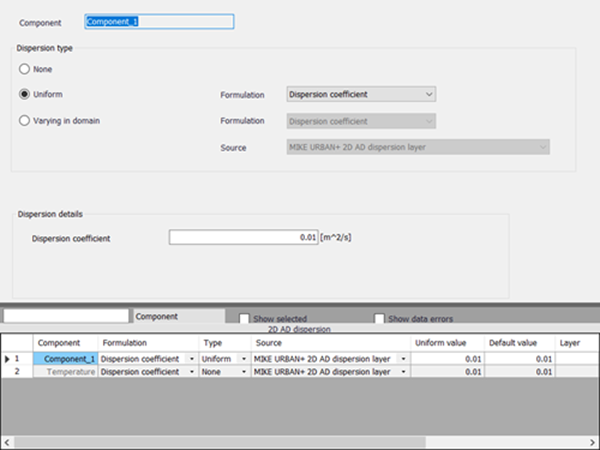
Figure: 2D AD Dispersion editor