Two-dimensional Tables
The two-dimensional tables are used for tables defining an output value as a function of two input parameters.
The two-dimensional tables with type 'Time varying control rule' may be used in control rules where a relationship between an input value and a return value (output) changes over time.
Each row represents a specific date and time, for which the return values (output values) are specified in the table in the cells with white background, as a function of the input values specified in the top row with dark background.
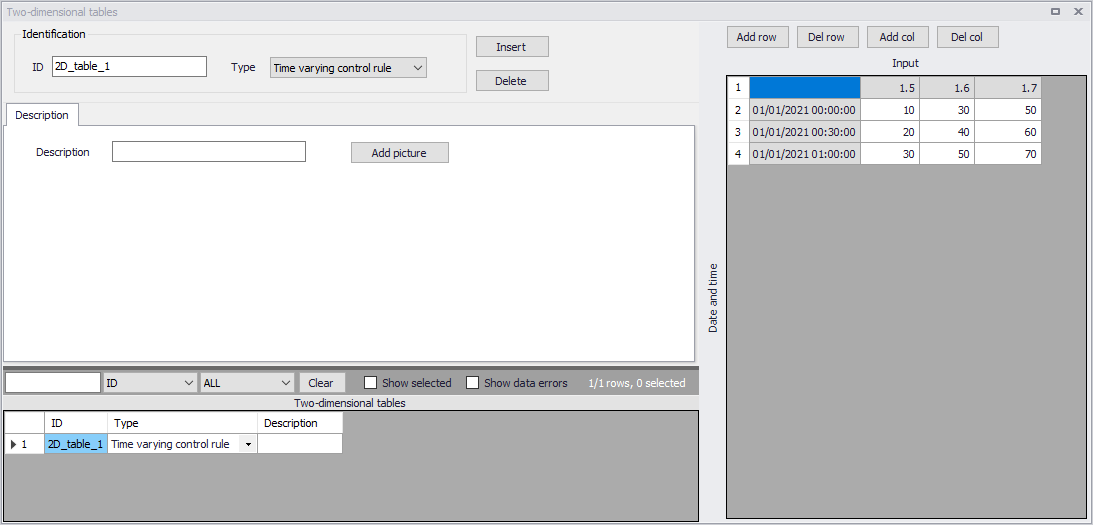
Figure: Two-dimensional tables Editor
The two-dimensional tables with type 'Generic control rule' are for use in control rules where the action value (output of the table) varies with any two input parameters. These two input parameters' values are respectively defined in the first row and the first column of the table (cells with dark background). This type of table is enabled in the 'Actions' editor when using the action type 'Set value from 2D generic table', where the two input parameters of the table are defined. Note that the unit of the output values from the table depends on the control type defined in the 'Actions' editor and is the same as what would apply with the action type 'Set value'.
The two-dimensional tables with type 'Tabulated Q' or 'Tabulated h' are used by tabulated structures on river networks, to define the relationships between the discharge in the structure and the upstream and downstream water levels.
The multiple two-dimensional tables with type 'Bridge' are used by bridge structures on river networks, to define the various coefficients that may be required for these structures.
The type of a table can only be selected when it is created, but cannot be changed afterwards.