Pipes Roughness
The hydraulic resistance in a conduit with sediment deposits originates from the pipe wall and from the sediment deposits on the bottom of the sewer. In general, the flow resistance from the sediment deposits consists of two contributions: one part originates from the grain friction and the other part originates from the expansion loss behind the bed forms (ripples, dunes, etc.). In MIKE+ ST, only the flow resistance from the sediment grains is calculated.
The total roughness in the pipe is calculated as a weighted average of the Manning number for the horizontal sediment surface and the wetted conduit walls. The roughness value of the horizontal sediment surface can be provided by the user or it can be calculated based on the sediment grain size and bed shear stress. Both methods can be applied globally (i.e. for entire model) and for individual conduits. Any local definition overrides the global specification.
The average shear stress in a pipe with sediment deposits is calculated from the Einstein side-wall elimination procedure. The calculation is based on the pipe roughness and the bed shear stress calculated from the sediment de-posits.
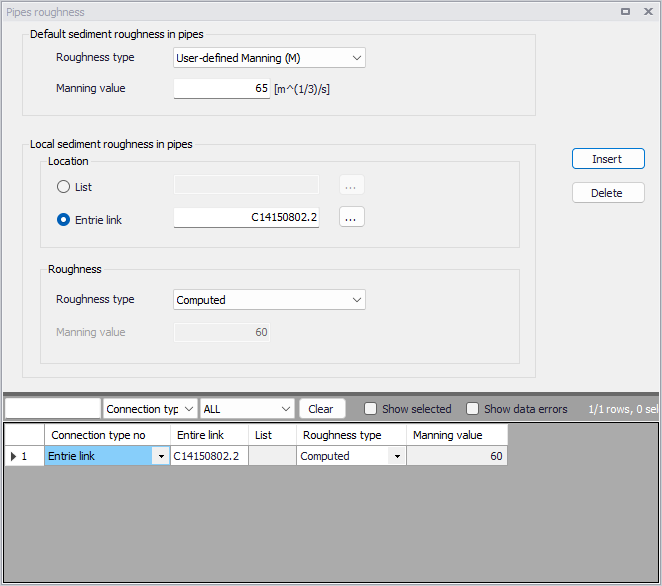
Figure: The 'Pipes roughness' editor
When the local value is applied to a 'List', then all pipes included in the selected list will be applied the selected method.