Model Type
The ‘Model type’ editor provides an ‘at a glance’ view of which MIKE+ features and modules are active. Active features and modules control the menus being accessible from the Setup tree view.
Within the "Rivers, collection system and overland flows" working mode, you can choose to have the following features activated:
- Catchments
- Collection system network
- River network
- 2D overland
Catchments can be connected to both Collection system and River networks. Collection system and River networks can also be connected together. When 2D overland is enabled with Collection system network and/or river network, couplings between the various features are enabled automatically.
You can then activate the following modules, which will apply to all selected features whenever relevant:
- Rainfall Runoff (RR): The RR module simulates hydrological processes on catchments. Enabling the Catchments feature but without including the RR module allows applying catchment discharge to the collection system and river networks.
- Hydrodynamic (HD): The HD module simulates the flows in collection system networks, river networks and/or 2D overland, depending on the selected features. The HD module includes the two sub-modules Control Rules (only apply applicable to Collection system and River networks) and Long Term Statistics (LTS), only applicable to the Collection system network.
- Transport (AD, SWQ): The transport module simulates the Advection-Dispersion processes (for e.g. pollution transport) in collection system networks, river networks and/or 2D overland, depending on the selected features. The transport option also enables stormwater quality (SWQ) simulations on catchments, when Catchment feature and Rainfall-Runoff module are active.
- Water quality (MIKE ECO Lab): The MIKE ECO Lab module simulates the advanced water quality processes (e.g. biological processes) in collection system networks, river networks and/or 2D overland, depending on the selected features.
- Sediment transport (ST): The ST module simulates transport of sediments in collection system and river networks. It is not available for 2D overland.
- Data assimilation (DA): The DA module uses available observations to rectify the simulation, which thereby obtains a reduced deviation from the observed values. DA is particularly relevant for real-time forecasting, where it serves to improve the numerical state of the network up to time of forecast. When the initial condition of the forecast is improved, the forecast accuracy becomes better, and this makes the prediction more reliable. DA is available for River models for the HD and AD modules.
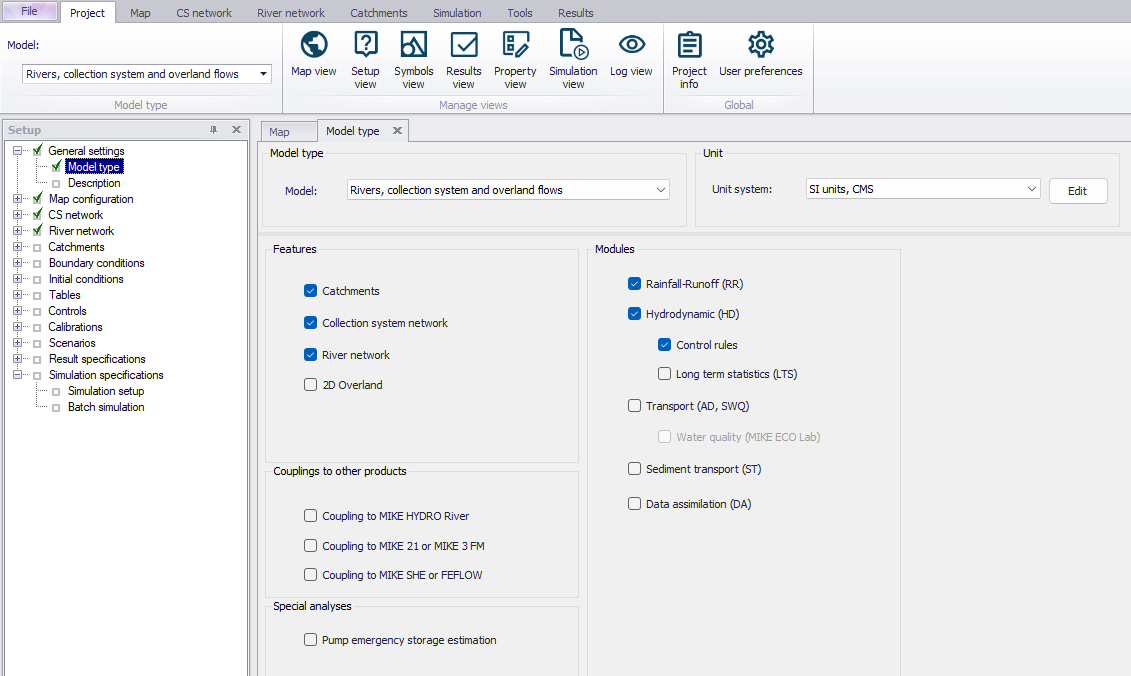
Figure: Model type and module selection
The following couplings to other MIKE products are also available:
- Coupling to MIKE HYDRO River: When this is active, the desired MIKE HYDRO model setup file must be selected in the 'River model' page. Note that coupling AD module with MIKE HYDRO is allowed and automatically enabled when the 'Transport (AD, SWQ)' module is also included in the simulation setup. AD components' names in MIKE HYDRO must, however, be identical to the components' names in MIKE+.
- Coupling to MIKE 21 or MIKE 3 Flow Model FM: When this is active, the desired MIKE 21 FM or MIKE 3 FM model setup file must be selected in the 2D / 3D overland model' page. Note that this coupling cannot be enabled at the same time as the 2D overland feature, since only one source of overland model can be used at a time.
- Coupling to MIKE SHE or FEFLOW: When this is active, it is possible to define parts of the river network to be coupled to a MIKE SHE or FEFLOW model. The network simulation file (*.m1dx file) must then be exported from MIKE+ for use in MIKE SHE or FEFLOW. This also allows coupling the collection system network to MIKE SHE: in that case, the corresponding coupling file (*.couple) must also be exported from MIKE+ for use in MIKE SHE.
When the different features and modules are activated, the corresponding menus will be added in the Setup view. Note that the features and modules are actually included in a simulation only if they are also included the simulation definition, from the 'Simulation setup' editor.
The 'Pump emergency storage estimation' option enables a special type of analysis for collection system networks, enabling extra simulation options under the 'Special analysis' group in the Setup tree view. It estimates the time and volume available prior to an overflow at the wastewater pump station assets in the event of system failure.