Sediment Removal in Basins
Basins act as "sediment traps" because the water flow kinetic energy and turbulence (hence, dynamic forces acting on sediments) are much lower than in the conduits. Sedimentation in basins may in some cases be an unwanted side-effect and an operational problem (need for frequent sediment removal), while in other cases it may be deliberately designed to induce sedimentation.
MIKE+ ST does not simulate sedimentation in basins: both non-cohesive and cohesive fractions continues unaffected by default through basins (actually, through any node in the model).
However, effect of basins on sediment transport of non-cohesive fractions may be emulated by defining a sediment removal efficiency in individual basins. This function simply removes the specified fraction of the transport rate (named ‘Settling factor’) from the model.
Cohesive sediments are not affected by this function.
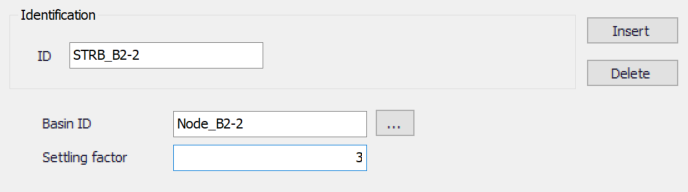
Figure: The 'Sediment removal in basins' editor
Fields from the 'Sediment removal in basins' editor are described in the table below.
| Edit field | Description | Unit SI | Unit US |
|---|---|---|---|
| ID | Unique identifier of sediment removal definition | - | - |
| Basin ID | Identifier of actual basin | - | - |
| Settling factor | Turbulence constant indicating the settling performance of the basin 1: poor performance 3: good performance 5: very good performance : ideal performance | - | - |
Table: 'Sediment removal in basins' editor data fields
The sediment removed in basins can be reported in result files for each basin individually as sediment and mass transport (instantaneous and accumulated) for each ST fractions separately and for total sediment transport.
Note
This functionality is available only for basin nodes on collection system networks. It is not available in storages from river networks.