Pressure Dependent Demands
Scientific description
Traditionally, water demands are defined prior to the simulation and thus independent of the actual pressure. With the Pressure Dependent Demands, the Wagner equation can be used to adjust the node demands based on the available pressure.
Pressure Dependent Demands analysis is an alternative computational method based on pressure driven analysis comparing to the traditional demand driven analysis. Node demands are automatically adjusted based on the available pressure. This approach can be used to model intermittent water supply, low pressure situations, and it is also suitable for modelling system shut-down and maintenance.
There are three formulations of the demand versus pressure relation that can be used in computation: Wagner, Tucciarelli, and Fujiwara equation. They all adjust the node demand based on the available pressure.
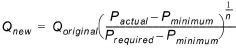
Wagner equation1 reads:
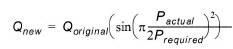
Tucciarelli equation2 reads:
Fuijiwara equation3 reads:

where:
- Qnew = adjusted node demand
- Pactual = actual pressure
- Prequired = required pressure (such as e.g. 15 m), node demand is equal to the original demand if the pressure (such as e.g. 5 m), node demand is 0 if the pressure drops below the minimum pressure
- n = coefficient with recommend values between 1.5 and 2.0 (2.0 is recommended by Wagner).
Note
Nodes with negative demand i.e. inflow nodes are excluded from the above equation.
The Pressure dependent demands editor
A list of the Pressure dependent demands attributes follows, with a short description given for each one.
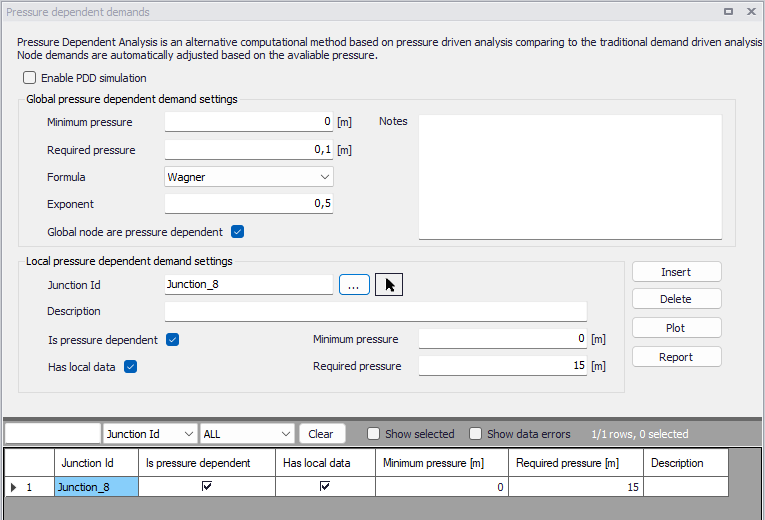
Figure: The Pressure dependent demands editor
- Minimum pressure: This data entry allows you to define the minimum pressure (such as 5m), node demand is 0 if the actual computed pressure drops below the minimum pressure
- Required pressure: This data entry allows you to define the required pressure (such as 10m), node demand is equal to the original demand if the actual computed pressure is above the required pressure.
- Formula: This data entry allows you to select the equation that will be used to compute pressure dependent demands. The options are Wagner equation,
- Wagner exponent: This data entry allows you to define the coefficient "n" for the exponent in Wagner equation (exponent = 1/n).
- Global nodes are pressure dependent: This data entry allows you to activate pressure dependent demands for all nodes unless they are locally changed using the “has local data” option. Similarly, if you only want several specific nodes (demands) to be pressure dependent, unselect this data check box and use local data to define pressure dependent nodes.
- Notes: This data entry allows you to enter any notes or further descriptions.
- Insert/delete: Allows you to add or remove local data.
- Junction ID: This data entry allows you to define the local node. Use “…” to select the junction node from the list or use the arrow “” to select the junction node from the Map.
- Description: This data entry allows you to provide user defined description.
- Is pressure dependent: This data entry allows you to define the local node as either “pressure dependent” or “not pressure dependent”.
- Has local data: This data entry allows you to define if the local node shares the global pressure settings or whether it will use its own pressure settings (local data).
- Minimum pressure (local data): This data entry allows you to define the minimum pressure that will apply only to the local node.
- Required pressure (local data): This data entry allows you to define required pressure that will apply only to the local node.
Running simulations
Click the 'Run' button to run the simulation. The simulation progress will be displayed in the application status window. The simulation can be interrupted (cancelled) by pressing the Esc key.
Pressure Dependent Demand Results
Results of the Pressure dependent demands simulations can be displayed as other results for the standard hydraulic simulations. However, there are several additional results items that can be used in data display:
- Node demand (pressure depended requested)
- Node demand (pressure depended supplied)
- Node demand (pressure depended deficit)
- Node demand (pressure depended supplied percentage).
-
J. Wagner, U. Shamir, D. H. Marks (1988) "Water distribution reliability: Simulation Methods." J Water Resour Plan Manage Div Vol. 114.3: 253-275 ↩
-
T. Tucciarelli, A. Criminisi, D. Termini (1999) Leak Analysis in Pipeline Systems by Means of Optimal Valve Regulation. Journal of Hydraulic Engineering 125(3): 277-285. ↩
-
O. Fujiwara and T. Ganesharajah (1993) Reliability assessment of water supply systems with storage and distribution networks. Water Resources Res 29.8: 2917-2924. 10.1029/93WR00857 ↩