Sediment Transport Boundary Conditions
Sediment transport boundary conditions are only relevant for morphological analysis. For "Hydraulic effects only" type of analysis, no sediment boundary conditions are needed. Any active sediment boundary conditions is ignored if the sediment transport analysis is specified as "Hydraulic effects only".
Sediment transport boundary conditions may be specified at any inflow boundary in the model (upstream boundary) and at outlet water level boundaries (downstream boundary).
Sediment inflows to a drainage or river model can be specified either in association with catchment model or with network model, defined as "WQ boundary prop-erties" for the any hydraulic or SWQ boundary conditions.
For most of boundary condition types, the sediment boundary properties are specified directly as sediment concentration in the inflowing water. For SWQ boundaries, sediments inflows are defined either as a tabular function (specific runoff vs. sediment concentration) or are calculated by SWQ advanced methods (BuildUp/WashOff and EMC).
A schematic overview over the possible types of sediment boundary conditions for collection system networks is presented in the table below.
Note
When running an integrated simulation (Catchment + Network simul-taneously), sediment outputs from the catchment model are automatically transferred to the network model at the locations of catchments connections to the network model. If the simulations of catchment and network models are run separately in a sequence, the catchment model's sediment outputs must be specified as WQ boundary properties of the corresponding hydraulic boundary conditions to the network model.
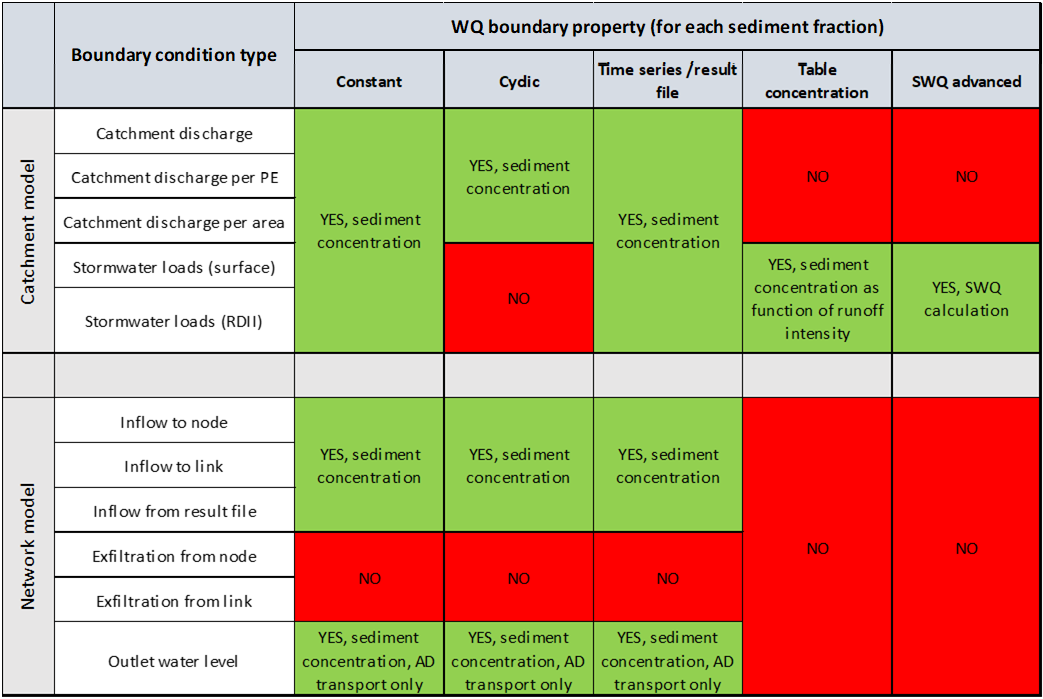
Table: Overview over possible sediment boundary conditions for collection system networks
Refer to the 'Water Quality Boundary Condition Properties' editor for additional details about definition of boundary conditions.