Streets
Streets are geometric cross section data describing the shape of a street or roadway. The street dimensions are to be provided for the portion of the street extending from the high point of the roadway to the curb and beyond to any backing that might exist. It can later be used to describe the geometry of conduits defined with the conduit shape 'Street'.
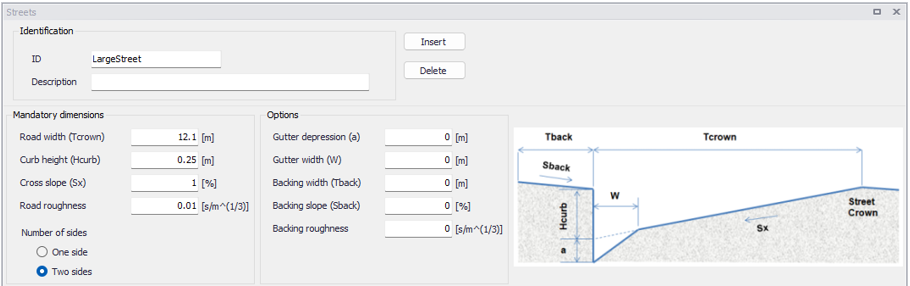
Figure: The SWMM Streets editor
For each Street shape, the following mandatory settings must be specified:
- ID: the unique identifier of the street cross section.
- Road width (Tcrown): the distance from the curb to the high point of the street roadway (i.e., the street crown).
- Curb height (Hcurb): the height of the curb with respect to the street's cross slope.
- Cross slope (Sx): the slope of the roadway part of the cross section.
- Road roughness: Manning's n roughness coefficient for the street surface. Typical values range from 0.013 to 0.017.
- Number of sides: select 'One side' if the street section extends only to the street crown or 'Two sides' if the same shape exists on the opposite side of the street crown.
The following optional settings may also be entered:
- Gutter depression (a): the distance that the gutter portion of the street is depressed below where the cross slope of the roadway would intersect the curb. Depressed gutter sections increase the conveyance capacity of a street. If the gutter maintains the same slope as the roadway, the gutter depression depth should be 0.
- Gutter width (W): the width between the curb and the roadway for a depressed gutter. For gutters with no depression depth, set the width to 0.
- Backing width (Tback): the width of the area that the street backs up against (e.g. sidewalk or lawn area). Set to 0 if there is no backing.
- Backing slope (Sback): the slope of the backing area.
- Backing roughness: Manning's n roughness coefficient for the backing's surface. This parameter is ignored if the backing width is 0.