Point Constituent Source
The Point Constituent Source editor, as shown in the figure below, allows to specify at which nodes an external chemical constituent enters the network system. At least one node in the network (with its ‘Is active’ box selected) must be specified as a point source of chemical constituent when performing a chemical concentration analysis. There are three sections in this configuration window.
New sources are added with the 'Insert' button.
Nodes which are not listed as a source in this editor are assigned an initial water quality of zero by default.
ID
This is the identifier of the source.
Node ID
This defines the ID of the node the point constituent is being assigned to. The appropriate node type and ID can be selected from the node list or on the map.
Node Type
This pull-down selection list allows to select what type of node (i.e., junction, reservoir, or tank) the point constituent is being specified for.
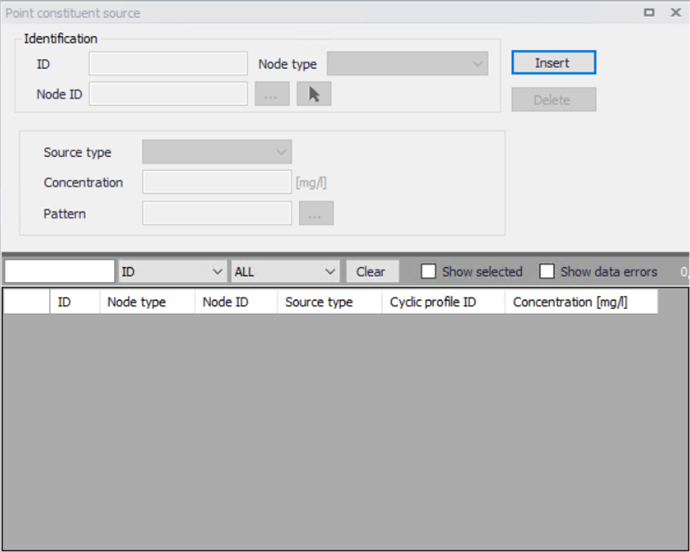
Figure: Layout of Point Constituent Source
Source Type
Water quality sources are nodes where the quality of external flow entering the network is specified. They can represent the main treatment works, a well-head or satellite treatment facility, or an unwanted contaminant intrusion.
Source quality can be made to vary over time by assigning it a time pattern. MIKE+ can model the following types of sources:
- A concentration source fixes the concentration of any external inflow entering the network at a node, such as flow from a reservoir or from a negative demand placed at a junction.
- A mass booster source adds a fixed mass flow to that entering the node from other points in the network.
- A flow paced booster source adds a fixed concentration to that resulting from the mixing of all inflow to the node from other points in the network.
- A setpoint booster source fixes the concentration of any flow leaving the node (as long as the concentration resulting from all inflow to the node is below the setpoint).
The concentration-type is best suited for nodes that represent source water supplies or treatment works (e.g., reservoirs or nodes assigned a negative demand). The booster-type source is best suited for direct injection of a tracer or additional disinfectant into the network or for a contaminant intrusion.
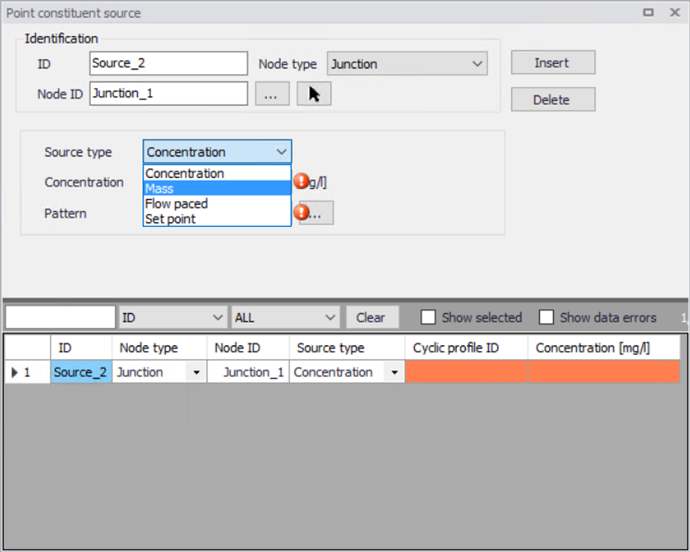
Figure: Source Type options
Concentration
This value specifies the baseline concentration (typically in mg/liter) of the constituent entering the node as an external source.
Pattern ID
This defines the ID of the constituent pattern to be applied to the specified baseline concentration entering the node. If a pattern ID is omitted for the specified source node, then there is no variation in the source strength of the constituent.
The  button allows to display the list of available pattern, where the appropriate pattern ID can be selected.
Point constituent source concentration time patterns are similar in concept to demand patterns. Each concentration time pattern consists of a set of multipliers that are multiplied to the specified baseline concentration over the extended period simulation. This allows to model changes in the amount of constituent applied at a node over an extended period simulation. See the section on Cyclic Profiles for further information on time patterns.
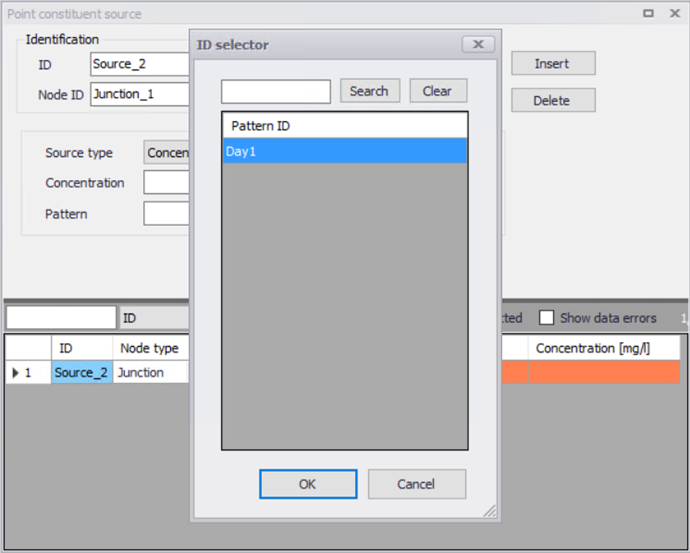
Figure: ID Selector window