Sediment Removal in Weirs
Weirs act as efficient barriers for non-cohesive sediment transport, as the weir crest levels are normally significantly higher that the conduit's invert. This means that significant part of non-cohesive sediment cannot be transported over weirs.
MIKE+ ST simulates effect of weirs on transport of non-cohesive sediments by defining a constant sediment removal efficiency or removal efficiency as function of weir discharge. This function simply removes the specified fraction of the non-cohesive fractions’ transport rate from the weir flow. This removal fraction can either be constant in time, or be a function of the discharge (as defined in a 'Removal efficiency' table).
Cohesive sediments are not affected by this function.
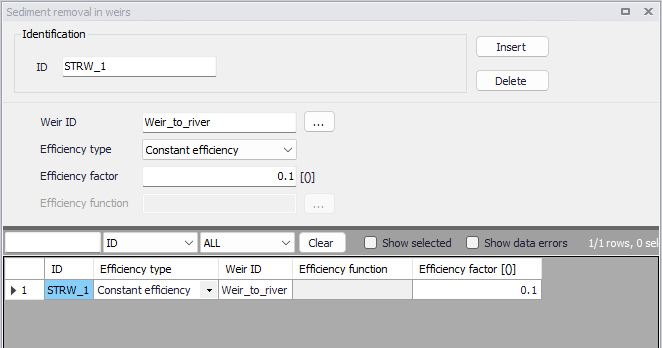
Figure: The 'Sediment removal in weirs' editor
Fields from the 'Sediment removal in weirs' editor are described in the table below.
| Edit field | Description | Unit SI | Unit US |
|---|---|---|---|
| ID | Unique identifier of sediment removal in weirs definition | - | - |
| Weir ID | Identifier of actual weir | - | - |
| Method | Constant efficiency: sediments removal by efficiency factor Efficiency (flow): sediment removal efficiency specified as function of weir flow | - | - |
| Efficiency factor | Fraction of non-cohesive sediment to be removed from the actual weir flow (only with "Constant efficiency") | ||
| Efficiency function | Reference to a tabular function of type "Removal efficiency" (only with "Efficiency(flow)") |
Table: 'Sediment removal in weirs' editor data fields
The sediment removed in weirs can be reported in result files for each weir individually as sediment and mass transport (instantaneous and accumulated) for each ST fractions separately and for total sediment transport.
Note
This functionality is available only for weirs on collection system networks. It is not available in weirs from river networks.