MIKE ECO Lab Forcings
Forcings are external variables which affect some of the processes on the state variables. They are automatically listed in this editor when the MIKE ECO Lab template is imported, from the 'MIKE ECO Lab templates' editor.
Forcings are “Built-In” or “User-Defined”, depending on the forcing definition in the MIKE ECO Lab template. “Built-in” means that forcings are provided by the hydraulic model through coupling with MIKE ECO Lab. “User Defined” forcings must be provided by the user, and can be either constant values (constant in time and domain), varying in time or varying in domain and time (the latter option is only enabled when the MIKE ECO Lab template is connected to the 2D overland model).
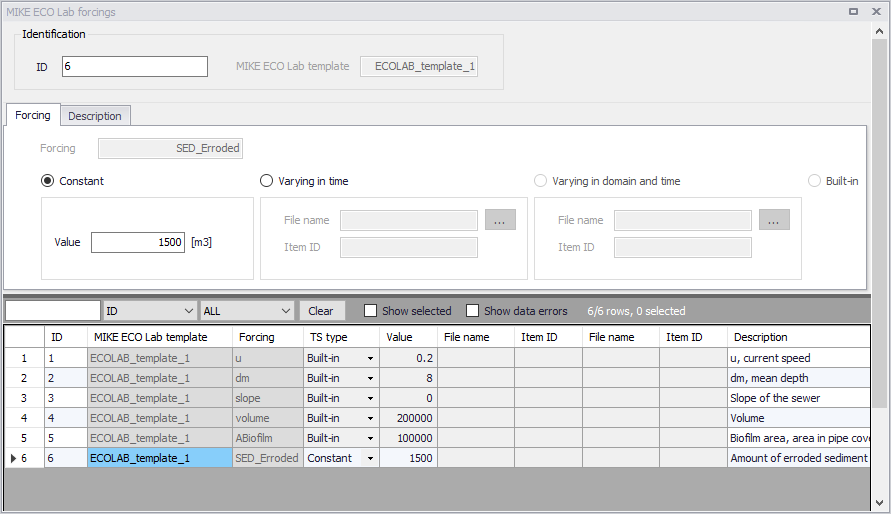
Figure: The MIKE ECO Lab Forcings editor
The editor is used for setting the user-defined forcings associated with the loaded MIKE ECO Lab templates:
- ID: Forcing identifier in MIKE+.
- MIKE ECO Lab template: MIKE+ ID for the template to which the forcing belongs.
- Forcing: Forcing identifier in MIKE ECO Lab template.
- Value: Constant value for the forcing.
- File Name: Path/file name for the *.dfs0 time series file containing forcing time series data, or for the 2D data file when the forcing is varying in domain and time.
- Item: Data item selected in the file.
- Description: Free text description for the forcing defined via the Description tab page.
Built-In forcings are also imported into MIKE+, but don't need any configuration.
Note
Note that the active fields in the editor are only those for specifying forcing constant values or input files. The remaining fields are read-only.
Note
Note that for templates connected to the 1D network, some forcings may be defined as built-in in the template but appear as user-defined in MIKE+, in case the corresponding variable does not exist in the model setup. That is especially the case for Temperature and Salinity forcings. In order for them to actually work as a built-in forcing, it is necessary to include a WQ component with the corresponding type (temperature or salinity).