Bioretention Cell
Bioretention Cells are terrain depressions that comprise of selected types of vegetation, resistant to the extended periods of high moisture and extreme levels of nutrient concentrations (Nitrogen and Phosphorus) found in stormwater runoff, grown in an engineered soil mixture above a gravel drainage bed. They provide storage, infiltration and evaporation of both direct rainfall and runoff captured from the collecting area surrounding the cell. Rain gardens, street planters, and green roofs are all different types of bioretention cells.
The different structural layers of this feature are:
- Surface
- Soil
- Storage
- Drain (optional)
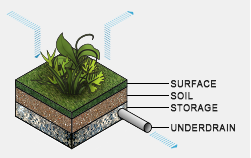
Figure: Bioretention cell structure layers
These are illustrated in the above figure. There are one or several relevant hydrological processes associated with each layer.
In the surface occur surface storage, surface infiltration, the collecting area run-on, surface evaporation and overflow.
In the soil layer occur percolation (vertical water movement to the storage layer), evapotranspiration (loss due to the plant root action) and storage in the soil's voids.
In the storage layer, stormwater provided by the percolation through the soil layer is detained in the storage layer's voids. Infiltration (leakage) to the native soil through the storage bottom, controlled by the characteristics of the surrounding soil, restores the storage capacity.
An optional underdrain may be included to empty the storage. The underdrain is activated (with the specified capacity) when the water level in the storage reaches the offset level.