Rainfall-Runoff Modelling
MIKE+ provides a versatile set of tools and computational models for modelling surface storm runoff and infiltration on urban and semi-rural catchments. The User can quickly prepare a precipitation-runoff model setup of desired level of detail (in terms of spatial discretization and input data) and use the computed runoff as a load to the collection network.
This Chapter provides a comprehensive guide for the preparation of hydrological models.
Modelling of urban storm runoff and infiltration requires understanding of information requirements and the involved processes. This understanding is supported by the illustration in the figure below. Note that MIKE+ can model rainfall-dependent infiltration (RDI). This is specifically discussed within the Parameters RDI section, and is not visually represented in the figure below.
Although runoff computation and its subsequent use as a network load are, in principle, two distinct steps in the modelling process, MIKE+ has the facility to simulate the two processes simultaneously.
Runoff modelling engages the following:
- Catchments
- Optionally (only if network computations will follow), definition of the catchment connection, i.e. specification of the point of runoff inflow into the network.
- Definition of the hydrological models
- Precipitation (optionally, temperature and evapotranspiration)
- Runoff computations
The runoff is typically used as a hydraulic load to the collection network. This requires:
- Declaration of the computed runoff as a network hydraulic load
- Execution of the network computation.
Runoff and hydrodynamic network computations are run simultaneously in MIKE+. Nevertheless, they can also be launched in two distinct steps, if needed.
Furthermore, an important part of successful modelling is related to model calibration and verification, which ensure that the computed results fit reasonably well with the flow observations. The calibration and verification are important engineering activities in the modelling process, and they must be paid due attention.
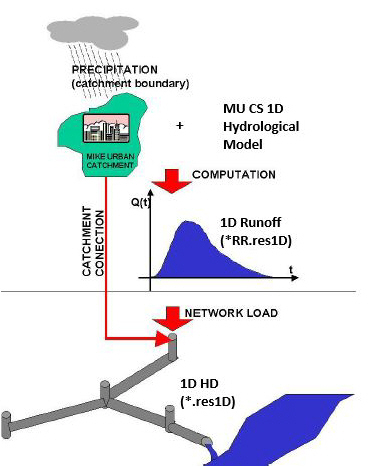
Figure: Illustrated flow of information in hydrological modelling