Snowpacks
The snowmelt routine is part of the runoff modelling process. It updates the state of the snowpacks associated with each catchment by accounting for snow accumulation, snow redistribution by areal depletion and removal operations, and snowmelt via heat budget accounting. Any snowmelt coming off the pack is treated as an additional rainfall input into the runoff process.
At each runoff timestep the following computations are made:
- Air temperature and melt coefficients are updated according to the calendar date.
- Any precipitation that falls as snow is added to the snowpack.
- Any excess snow depth on the plowable area of the pack is redistributed according to the removal parameters established for the pack.
- Areal coverages of snow on the impervious and pervious areas of the pack are reduced according to the Areal Depletion Curves defined for the study area.
- The amount of snow in the pack that melts to liquid water is found using:
- a heat budget equation for periods with rainfall, where melt rate increases with increasing air temperature, wind speed, and rainfall intensity
- a degree-day equation for periods with no rainfall, where melt rate equals the product of a melt coefficient and the difference between the air temperature and the pack's base melt temperature.
- If no melting occurs, the pack temperature is adjusted up or down based on the product of the difference between current and past air temperatures and an adjusted melt coefficient. If melting occurs, the temperature of the pack is increased by the equivalent heat content of the melted snow, up to the base melt temperature. Any remaining melt liquid beyond this is available to runoff from the pack.
- The available snowmelt is then reduced by the amount of free water holding capacity remaining in the pack. The remaining melt is treated the same as a direct rainfall input onto the catchment.
The SWMM Snowpacks editor and the Climatology editor contains the above information required for characterizing the modelling of the snowfall and snowmelt processes. The Snowpacks editor organizes the data into following groups:
- Identification
- Snowpack Data.
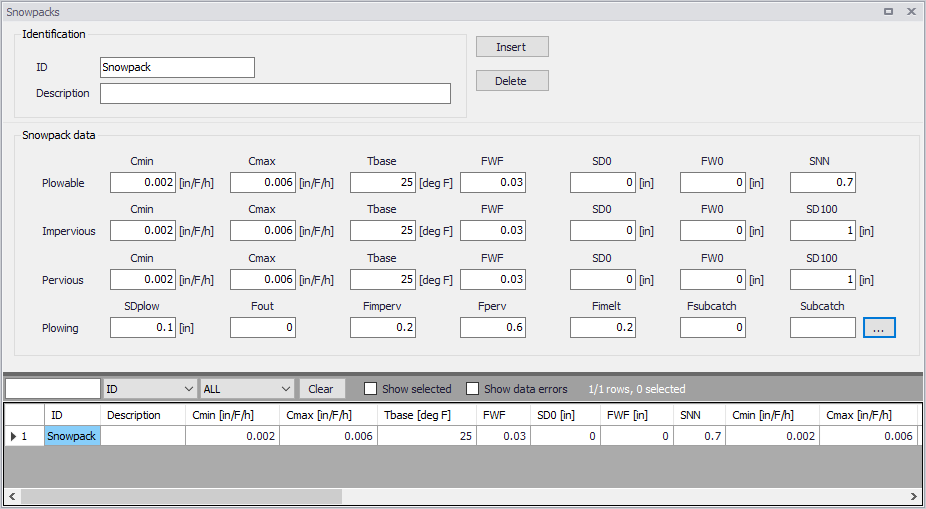
Figure: The SWMM Snowpacks editor
Identification
The Identification groupbox holds parameter set ID and optional descriptive information. Use the Insert or Delete buttons to add or remove records from the editor, respectively

Figure: The Snowpacks editor Identification group
| Edit field | Description | Used or required by simulations | Field name in datastructure |
|---|---|---|---|
| ID | Snowpack parameter set ID | Yes | MUID |
| Description | User-defined description for snowpack data | No | Description |
Table: Edit fields in the Snowpacks editor Identification group (mss_SnowPack)
Snowpack Data
Snowpack data characterize the buildup, removal, and melting of snow over Plowable, Impervious, and Pervious areas within a catchment. A set of snow removal parameters may also be defined for the Plowable area.
- Plowable: A user-defined fraction of the total impervious area representing such areas as streets and parking lots where plowing and snow removal can be done.
- Impervious: Covers the remaining impervious area of a catchment.
- Pervious: The entire pervious area of a catchment.
- Plowing: These parameters consist of the depth at which snow removal begins and the fractions of snow moved onto other areas.
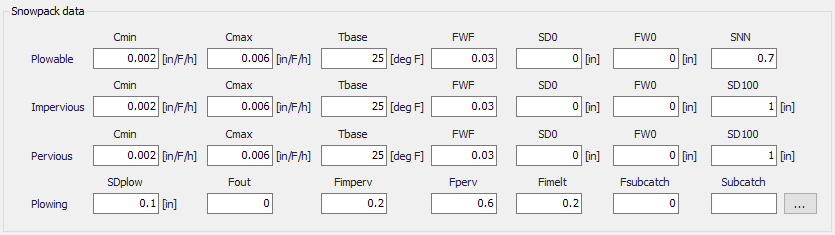
Figure: Snowpack Data group
| Edit field | Description | Used or required by simulations | Field name in datastructure |
|---|---|---|---|
| Plowable | |||
| Cmin | Minimum melt coefficient | Yes | Cmin1 |
| Cmax | Maximum melt coefficient | Yes | Cmax1 |
| Tbase | Snowmelt base temperature | Yes | Tbase1 |
| FWF | Ratio of free water-holding capacity of snow depth | Yes | Fwf1 |
| SD0 | Initial snow depth | Yes | Sd01 |
| FW0 | Initial free water in snowpack | Yes | Fw01 |
| SNN | Fraction of impervious area with depression storage that can be plowed | Yes | Snn0 |
| Impervious | |||
| Cmin | Minimum melt coefficient | Yes | Cmin1 |
| Cmax | Maximum melt coefficient | Yes | Cmax1 |
| Tbase | Snowmelt base temperature | Yes | Tbase1 |
| FWF | Ratio of free water-holding capacity of snow depth | Yes | Fwf1 |
| SD0 | Initial snow depth | Yes | Sd01 |
| FW0 | Initial free water in snowpack | Yes | Fw01 |
| SD100 | Snow depth above which there is 100% cover | Yes | SD1002 |
| Pervious | |||
| Cmin | Minimum melt coefficient | Yes | Cmin1 |
| Cmax | Maximum melt coefficient | Yes | Cmax1 |
| Tbase | Snowmelt base temperature | Yes | Tbase1 |
| FWF | Ratio of free water-holding capacity of snow depth | Yes | Fwf1 |
| SD0 | Initial snow depth | Yes | Sd01 |
| FW0 | Initial free water in snowpack | Yes | Fw01 |
| SD100 | Snow depth above which there is 100% cover | Yes | SD1003 |
| Plowing | |||
| SDplow | Depth of snow on plowable area at which redistribution through plowing occurs | Yes | SDplow |
| Fout | Fraction of excess snow on plowable area transferred out of watershed | Yes | Fout |
| Fimperv | Fraction of excess snow on plowable area transferred to impervious area by plowing | Yes | Fimperv |
| Fperv | Fraction of excess snow on plowable area transferred to pervious area by plowing | Yes | Fperv |
| Fimelt | Fraction of excess snow on plowable area converted into immediate melt | Yes | Fimelt |
| Fsubcatch | Fraction of excess snow on plowable area transferred to pervious area in another catchment | Yes | Fsubcatch |
| Subcatch | ID of catchment receiving the Fsubcatch fraction of transferred snow | Yes | SubcatchID |
Table: Edit fields in the Snowpack Data group (mss_SnowPack)
- Cmin: Minimum melt coefficient.
- Cmax: Maximum melt coefficient. The minimum and maximum snowmelt coefficients are used to estimate a melt coefficient that varies by day of the year. The latter is used in the following degree-day equation to compute the melt rate for any particular day. Melt Rate = (Melt Coefficient) * (Air Temperature - Base Temperature).
- Tbase: Snowmelt base temperature. Temperature at which snow begins to melt.
- FWF: Ratio of free water-holding capacity of snow depth. Fraction of snowpack depth which must fill with melted snow before liquid runoff from the pack begins.
- SD0: Initial snow depth. Depth of snow at the start of the simulation.
- FW0: Initial free water on the snowpack. Depth of melted water held within the pack at the start of the simulation. This number should be at or below the product of SD0 and FWF.
- SD100: Snow depth above which there is 100% cover. The depth of snow beyond which the entire area remains completely covered and is not subject to any areal depletion effect.
- SNN: Fraction of impervious area that is plowable.
- SDplow: Depth of snow on plowable area at which redistribution through plowing occurs. Depth which must be reached before any snow removal begins.
- Fout: Fraction of excess snow on plowable area transferred out of watershed. The fraction of snow depth that is removed from the system and does not become runoff.
- Fimperv: Fraction of excess snow on plowable area transferred to impervious area by plowing. The fraction of snow depth that is added to snow accumulation on the pack's impervious area.
- Fperv: Fraction of excess snow on plowable area transferred to pervious area by plowing. The fraction of snow depth that is added to snow accumulation on the pack's pervious area.
- Fimelt: Fraction of excess snow on plowable area converted into immediate melt. The fraction of snow depth that becomes liquid water which runs onto any subcatchment associated with the snowpack.
- Fsubcatch: Fraction of excess snow on plowable area transferred to pervious area in another catchment. The fraction of snow depth which is added to the snow accumulation on some other subcatchment. Define the subcatchment under ‘Subcatch’.
Catchments are assigned snowpack parameters through their Snowpack ID property in the SWMM Hydrology & Hydraulic Properties tab page of the Catchments editor.